The Ptolemaic Kingdom was one of the most influential Hellenistic states of the ancient world. Established after the death of Alexander the Great in 323 BC, it was founded by his general Ptolemy I Soter, who took control of Egypt and created a dynasty that would rule for nearly three centuries. The kingdom lasted from 305 BC until 30 BC, when it became part of the expanding Roman Empire after the death of its last ruler, Cleopatra VII.
Centered in the magnificent city of Alexandria, the Ptolemaic Kingdom combined Greek and Egyptian traditions. The rulers were Macedonian Greeks who adopted many aspects of Egyptian culture while maintaining Greek language and customs. Alexandria became one of the greatest centers of learning and commerce in the Mediterranean. The famous Library of Alexandria and the towering Lighthouse of Alexandria reflected the kingdom’s wealth and intellectual achievements.
Under rulers such as Ptolemy II Philadelphus and Ptolemy III Euergetes, the kingdom reached the height of its power. Its territories extended beyond Egypt to include Cyprus, parts of Syria, and several islands in the eastern Mediterranean. Agriculture, especially the cultivation of grain along the fertile Nile Valley, brought immense prosperity. Trade with Africa, Arabia, and Asia further enriched the kingdom, making it one of the strongest economies of the ancient world.
However, internal conflicts, struggles for succession, and wars with the neighboring Seleucid Empire gradually weakened Ptolemaic authority. By the first century BC, Roman influence had become increasingly dominant. Cleopatra VII attempted to preserve Egypt’s independence through alliances with Roman leaders Julius Caesar and Mark Antony. After their defeat by Augustus in 30 BC, Egypt was annexed by Rome, bringing the Ptolemaic era to an end.
The coins of the Ptolemaic Kingdom are among the most distinctive and admired in ancient numismatics. Most were struck in gold, silver, and bronze and featured realistic portraits of rulers. Early coins often displayed the image of Ptolemy I with the royal diadem and symbols associated with Alexander the Great, emphasizing continuity with Alexander’s empire. The reverse side commonly showed an eagle standing on a thunderbolt, which became the enduring emblem of the dynasty.
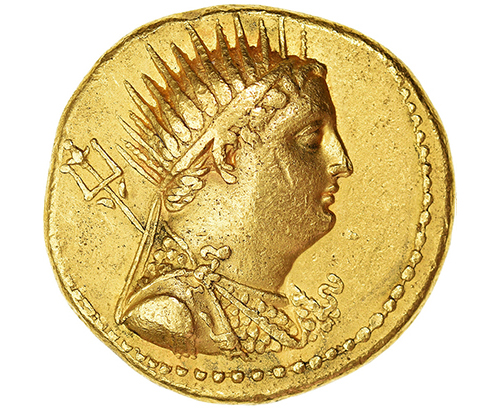
Ptolemaic coins were generally heavier than those used by other Hellenistic kingdoms because Egypt maintained its own monetary system. Gold octadrachms and silver tetradrachms circulated widely and facilitated trade throughout the Mediterranean. Later coins portrayed queens as well as kings, with Cleopatra VII appearing on issues that emphasized her royal authority and political ambitions. Inscriptions on the coins were written in Greek, reflecting the administrative language of the kingdom.
Today, Ptolemaic coins provide valuable evidence for historians and collectors. Their portraits, symbols, and inscriptions reveal the political history, artistic style, and cultural blending that characterized the Ptolemaic Kingdom. Together with its remarkable achievements in government, trade, and scholarship, these coins preserve the legacy of a dynasty that linked the worlds of Greece, Egypt, and Rome.
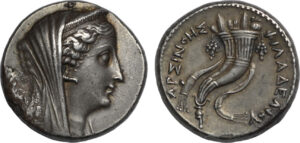
Egypt AR Decadrachm c. 249-246 BC Arsinoe II, posthumous issue struck under Ptolemy II VF
20,310.00 US$
Weight: 35.61 g – Diameter: 34 mm
Svoronos 961 area of horn silver on obverse, scarce
Numismaticus BV, Fixed Price List 1, 31
ex-“Philips” collection; bt. Seaby, March 1934 ex-Adolph Hess 221 (Lucerne, 18 December 1933), 132; ex-Randolph Laughlin (1875-1933) collection.
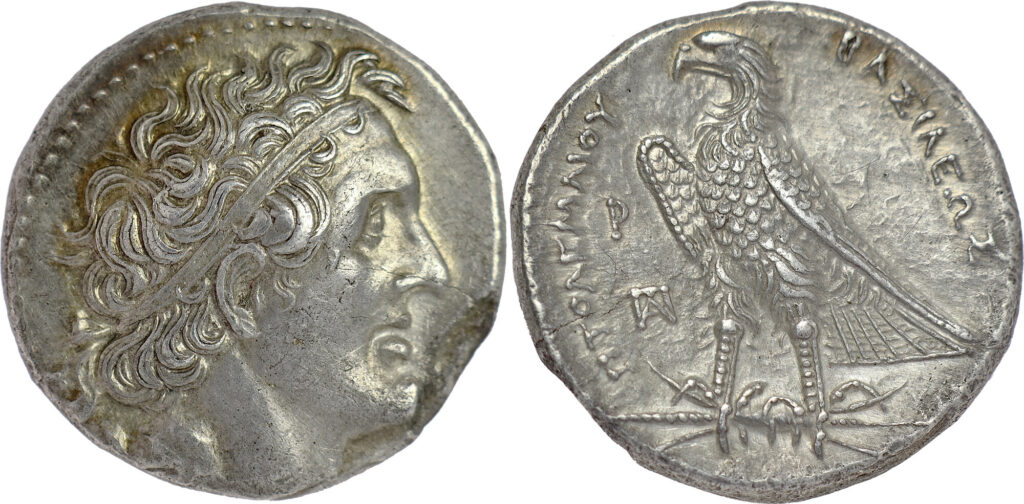
Tetradrachm ca. 199-198 BC Uncertain mint Egypt, Ptolemy V, Uncertain mint, Silver, NGC Ch XF
16,250.00 US$
Material: Silver
Weight: 14.28 g – Diameter: 26.30 mm
Mint mark: Uncertain mint
NGC certificate number: 6639646-012
Obv: Diademed and draped bust of boy king Ptolemy V Epiphanes to right.
Rev: Eagle standing left, wings closed, on thunderbolt, monogram to left.
Strike: 5/5 Surface: 4/5.
Uncertain mint, probably on the Levantine coast. Admirable and scarce tetradrachm of the young Ptolemy V, on which he is depicted in a realistic style portrait, representing him in person, a particularly rare fact for this dynasty.
This specimen is struck on a slightly oval flan, revealing the entirety of the engravings and even part of the engrailed ring.
There are nice golden tones in the hollows, only small scratches in the fields and very light flats on the highest reliefs, otherwise it is a coin in a superb state of preservation.
Catalog: CPE 1109; Svoronos 1258; Carlen & Lorber p. 169; Mørkholm, Coins 21 (A4/P7); SNG Copenhagen Supp. 1301 var. (also wearing aegis); BMC 55 var. (same); Boston MFA 2287.
BAΣIΛEΩΣ ΠTOΛEMAIOY
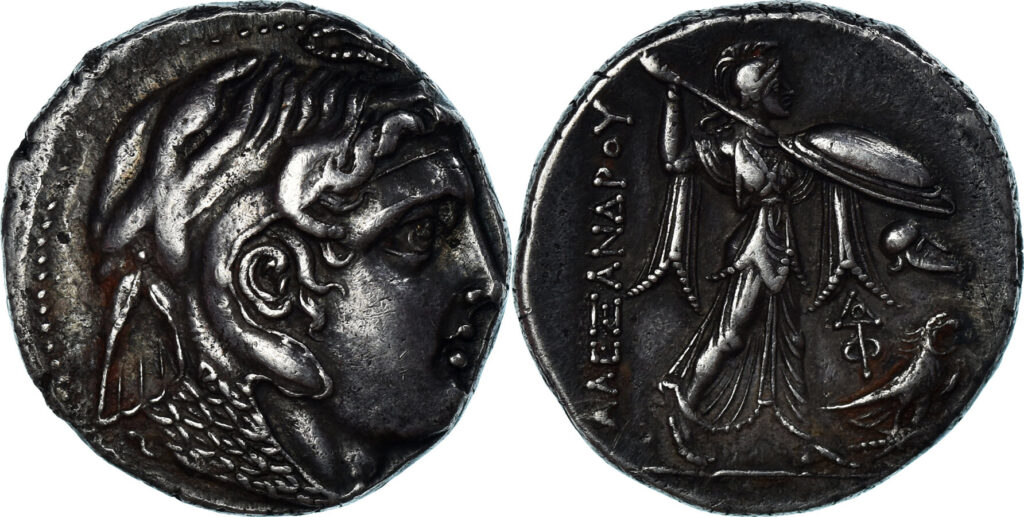
AR Tetradrachm ca. 306-300 BC Alexandria Egypt, Ptolemy I Soter, Alexandria, NGC Ch XF 4/5-4/5
10,200.00 US$
Material: Silver
Weight: 15.64 g – Diameter: 28.50 mm
NGC certification number: 6639706-001
NGC collectible ID: 756123
Pedigree: ‘signed’ Delta beside ear
Mint Mark: PTOLEMAIC KINGDOM
Notation: As Satrap, c.306-300 BC
Mint mark: Alexandria
Obv: Diademed head of the deified Alexander right, wearing elephant skin, aegis around neck, containing tiny Δ
Rev: Athena Alkidemos advancing right, brandishing spear and wearing shield on extended arm; to right, helmet, monogram, and eagle standing right on thunderbolt.
In the name of Alexander III of Macedon. Beautiful deep gray cabinet patina, with some very slight flats on the highest reliefs and a slightly off-center strike on the obverse.
With an engraver’s signature or satrap “Δ”. From the D.K. Collection. CPE 63 ΑΛΕΞΑΝΔΡΟΥ
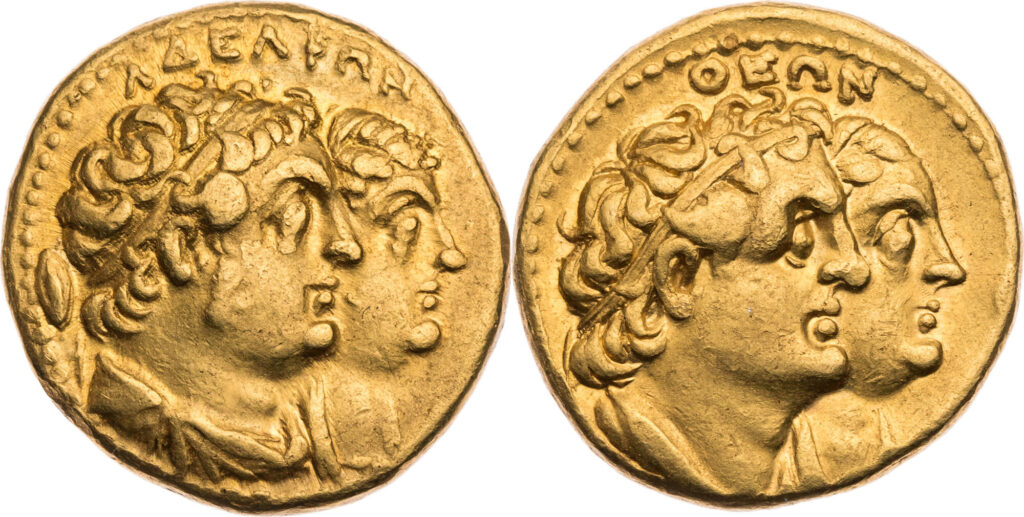
Egypt, Ptolemaic Kingdom, Tetradrachm, 272–261/0 BC, Ptolemy II Philadelphus VF+
8,700.00 US$
Catalog: Lorber, CPE 314; Svoronos 604; Olivier/Lorber 337 (Av31/Rv86) = this specimen
Material: Gold
Weight: 13.82 g – Diameter: 20.30 mm
Ptolemy II Philadelphus, 285–246 BC
Alexandria
Obv.: AΔEΛΦΩN, jugate busts of Ptolemy II Philadelphus and Arsinoe II right, shield behind
Rev.: ΘEΩN, jugate busts of Ptolemy I Soter and Berenice I right
ex Gorny & Mosch, Auction 185, 2010, Lot 200
ex Triton XIII, 2010, Lot 1354
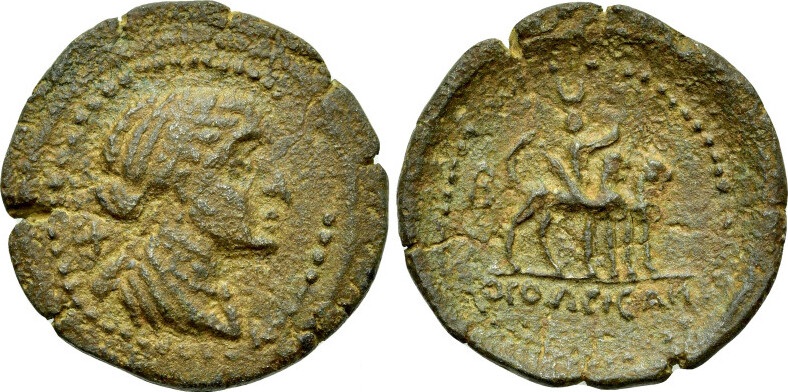
Egypt Bronze Ptolemaic Kings of Egypt, Cleopatra VII Thea Neotera (51-30 BC). Orthosis. Rare VF
4,060.00 US$
Material: Bronze
Weight: 5.90 g – Diameter: 22.00 mm
Orthoseia. Dated RY 2.
Obv: Diademed and draped bust right.
Rev: ΟΡΘΩϹΙЄΩΝ
Baal of Orthoseia driving biga drawn by griffins right; LB (date) to left.
Catalog: RPC I 4501; HGC 10, 210; DCA 600.
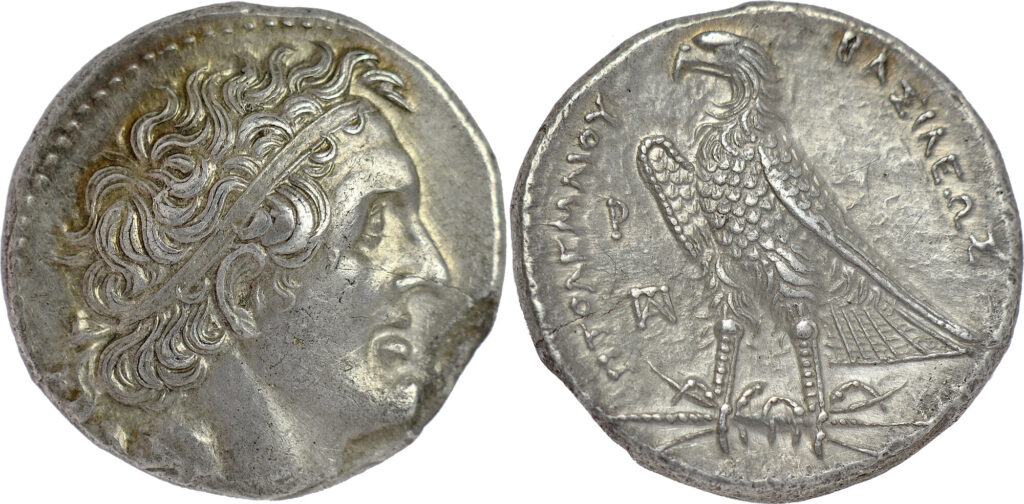
Ptolemaic Kings of Egypt AR Tetradrachm c. 294-282 BC Ptolemy I Soter – EF
2,260.00 US$
Catalog: Svoronos 256; BMC, Ptolemies, p. 15, 16
Material: Silver
Weight: 14.09 g – Diameter: 26.40 mm
Mint: Alexandria
Obverse: Diademed head of Ptolemy I right, wearing aegis around neck; small Δ behind ear; within pearl border; anepigraphic.
Reverse: Eagle with closed wings standing left on thunderbolt; in left field, P above monogram ΠA; legend around, ΠTOΛEMAIOY-BAΣIΛEΩΣ
Condition remark: Flan defect between 4 and 5 o’clock, otherwise well struck with bold reliefs; fine classical style; fine iridescent patina.
Historic context: A craftsman known only as the “Delta Master” cut some of the most artistic dies of Ptolemy’s coinage. He signed his work with a tiny Greek letter delta (Δ) hidden in a curl of hair behind the ear on the portrait.
Provenance: ex coin auction (NL)
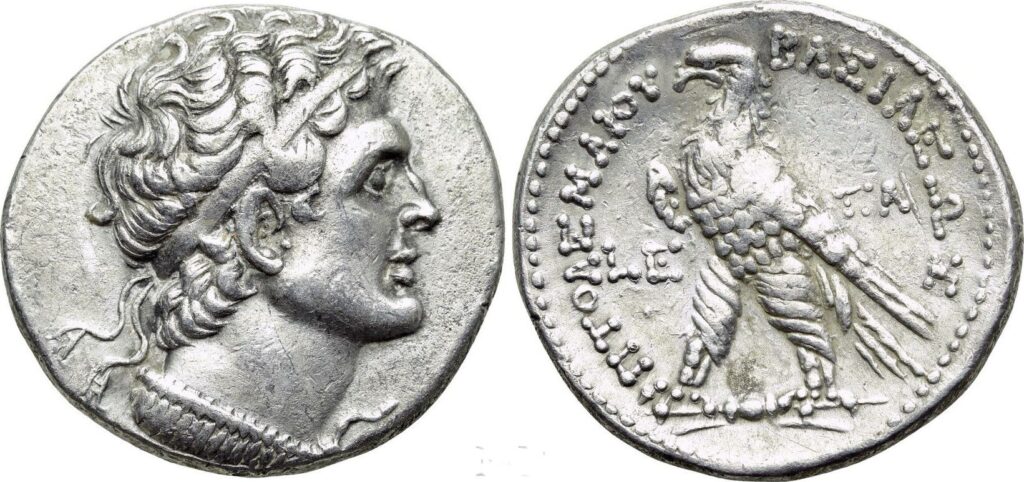
1,160.00 US$
Catalog: SNG Cop. 615 – Svoronos 1311
Material: Silver
Weight: 14.12 g – Diameter: 27.00 mm
Obv.: Diademed head of Ptolemy I right, with aegis around neck.
Rev.: Eagle standing left on thunderbolt; in left field, LE (date).
Fine, well-centered strike.
About Us:

MA-Shops.com, The World’s Most Trusted Numismatic Marketplace, offers more than a million ancient, U.S. and ancient coins, along with medals, banknotes, militaria and antiquities. Our vibrant collection is offered by verified and Certified Dealers from around the world. Collectors can search, select and purchase conveniently and confidently knowing every item is authentic and guaranteed. Founded in 2005 by Joachim Schwiening, MA-Shops has offices in Germany and the US.
To become a dealer or for more information, contact us at MA-Shops.com