Publius Licinius Egnatius Gallienus
Gallienus (Publius Licinius Egnatius Gallienus) was Roman emperor from AD 253 to 268, ruling during one of the most unstable periods in Roman history; the Crisis of the Third Century.
Born around AD 218, he was the son of Emperor Valerian, who prepared him early for power by granting him titles and responsibilities while still young.
Gallienus became co-emperor alongside his father in 253. Valerian focused on threats in the eastern provinces, while Gallienus governed the West, facing relentless pressure from Germanic invasions along the Rhine and Danube. Early in his reign, he struggled to contain tribes such as the Alamanni and Goths, while also dealing with internal rebellions by ambitious generals who proclaimed themselves emperors.
Disaster struck in 260 when Valerian was captured by the Persian king Shapur I—the only Roman emperor ever taken alive by a foreign enemy. Gallienus suddenly ruled alone, but his authority was widely challenged.
Several breakaway states emerged, most notably the Gallic Empire in the West under Postumus, and the de facto independent Palmyrene realm in the East under Odaenathus and later Zenobia. Though Gallienus could not immediately reunite the empire, he prevented total collapse.
In 268, while campaigning against the Goths and confronting another usurper, Gallienus was assassinated near Milan by officers involved in a conspiracy. His death marked the end of the Valerian dynasty. Though long criticized by ancient sources, modern historians increasingly view Gallienus as a resilient ruler who held the empire together during near-constant crisis, laying groundwork for the later recovery under emperors like Aurelian.
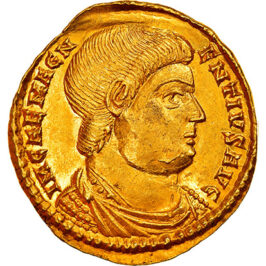
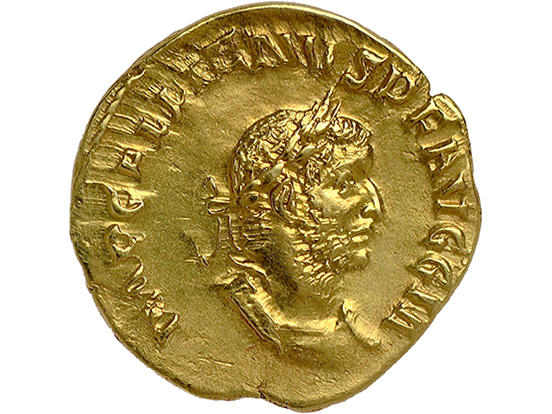
During his reign, coins were also minted bearing his image. See them here:
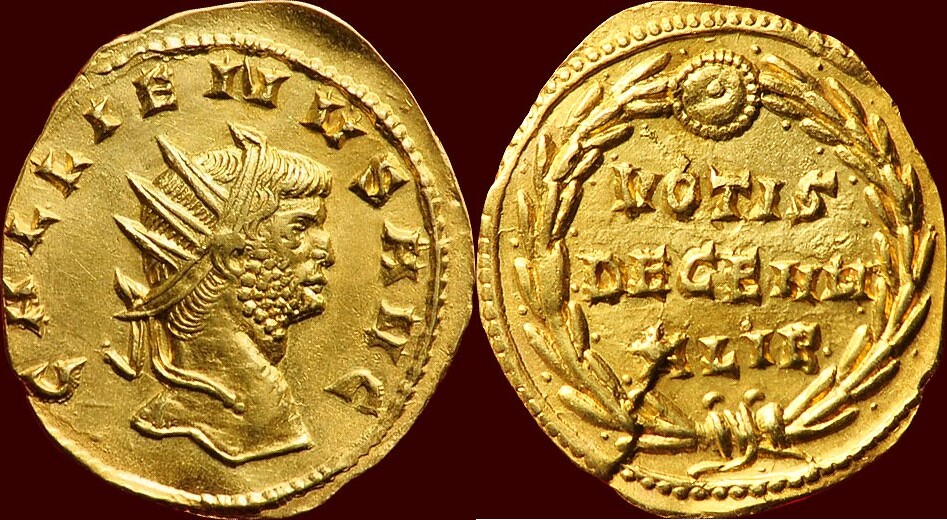
Aureus (262-263) Gallienus, 253-268 – AV Binio or Heavy Rome XF / XF-
28,930.00 US$
Catalog: antoninianus
Weight 5,20gr. | Gold Ø 22,5mm.
7th emission of Rome
Obv. Radiate head of Gallienus right, surrounded by the legend GALLIENVS AVG
Rev. Laurel- wreath tied with a ribbon at the bottom and decorated with a medallion at the top, with inside the legend VOTIS / DECENN / ALIB
Over the years, the weight of the aureus – the basic Roman denomination in gold – gradually declined. As late as the 1st century after Chr. it weighed about 7.5 g, while ca. 250 after Chr. it was already only half that.
By the time of Trebonianus Gallus, gold coins began to vary greatly in weight, as the standard was not strictly adhered to. In addition, this emperor was the first on a larger scale to introduce the binio, a coin weighing about 1.5 times that of the aureus, characterized by a portrait with a radial crown.
This is an obvious parallel to the treatment that for the first time was applied in 215 by Emperor Caracalla for silver and gold coins and resulted in the appearance, alongside the existing denarius, of the double denominations known today as the antoninianus (double denarius) and the binio (double aureus).
Most likely, the binio from Trebonianus Gallus and his successors was tariffed as one and a half or twice the weight of the aureus.
As with the aureus, the binio also varies greatly in weight during this period. It is presumed that binia were not circulating coins, but rather a kind of donation in the nature of rewards or gifts. So it was a prestigious coin intended for the payment of civil servants and soldiers.
This binio of Gallienus was minted for a special occasion, the “Votis Decennalibus”. This Latin phrase means “vows (or prayers) for the tenth anniversary of rule”. It was commonly found on the reverse of Roman coins to celebrate an emperor completing their tenth year in power and to express hopes for their continued reign.
♦Unpublished in standard reference literature. Extremely rare ♦
Catalog: Cohen – (cf. 1337) | cf. RIC 92 | MIR – (cf. 512 and 513) | Sear- (cf.10100) | Calicó 3664var. RRRR
Small die break. Attractive specimen with good portrait.
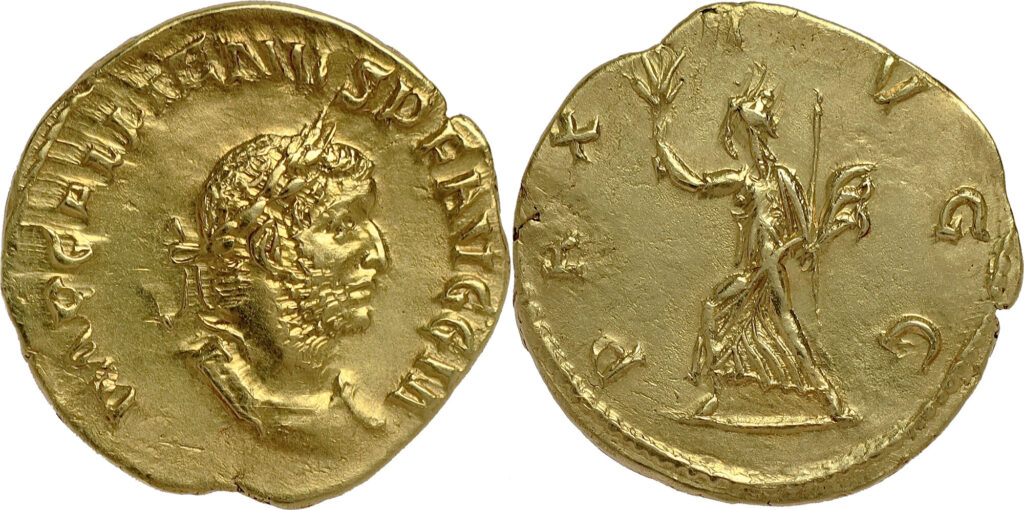
ROMAN EMPIRE AV Aureus 257 AD Gallienus AEF
8,850.00 US$
Catalog: Göbl MIR 160f (same dies); RIC V Gallienus (joint reign) 88 var.; Calicó 3567 corr. (sceptre not palm)
Material: Gold
Weight: 2.65 g – Diameter: 17.90 mm
Mint: Rome
Condition remark: Struck from slightly worn obverse die
Rarity: Of the highest rarity, apparently the second and by far the best example known.
Obverse: Bust of Gallienus, laureate and cuirassed, right; legend around: IMP GALLIENVS P F AVG G M
Reverse: Pax advancing left, draped, holding branch in right hand and sceptre and Aphlaston(?) in left hand; legend around: PAX-AVGG
Provenance: Ex Dr. Busso Peus Nachf. (DE), private sale 11/2018 (sold with original ticket); ex Numismatik Naumann, Auction 49 (8 Jan. 2017), L679 (hammer: 5000€ + commission, print-out included); ex Leu Numismatik AG, Auction 1 (25 Oct. 2017), L330 (hammer: 2800 CHF + commission, print-out included).
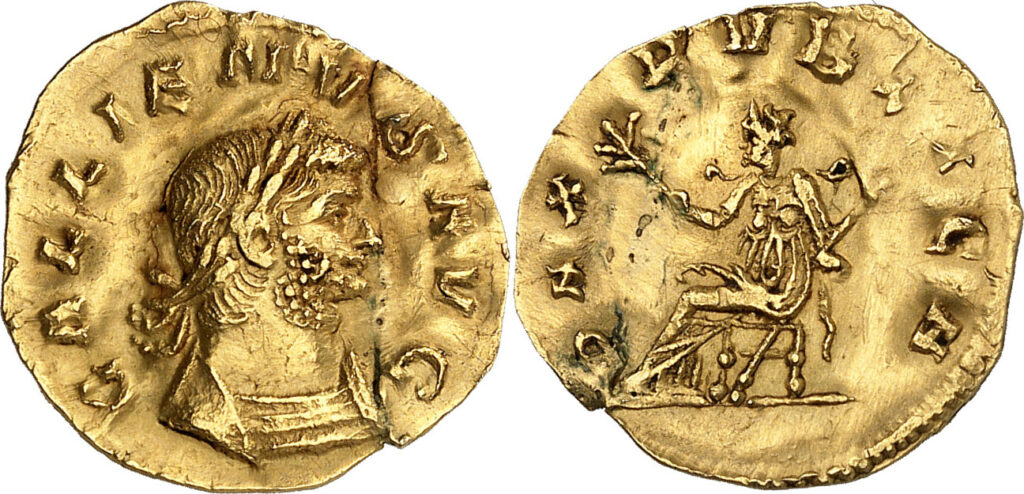
Aureus GALLIENUS, 253-268 about EF
5,490.00 US$
Obv/ GALLIENVS AVG. Armored bust with laurel wreath facing right
Rv/ PAX – PVBLICA. Pax seated left, branch in right hand, scepter in left arm
C 772 var. (200 Fr.); RIC 64; Göbl / MIR 552d (this specimen); Calicó 3568 var. (bust) 1.63 g. 12 h
Very rare. Slightly wavy, almost extremely fine
Acquired in 1963 from Spink, London
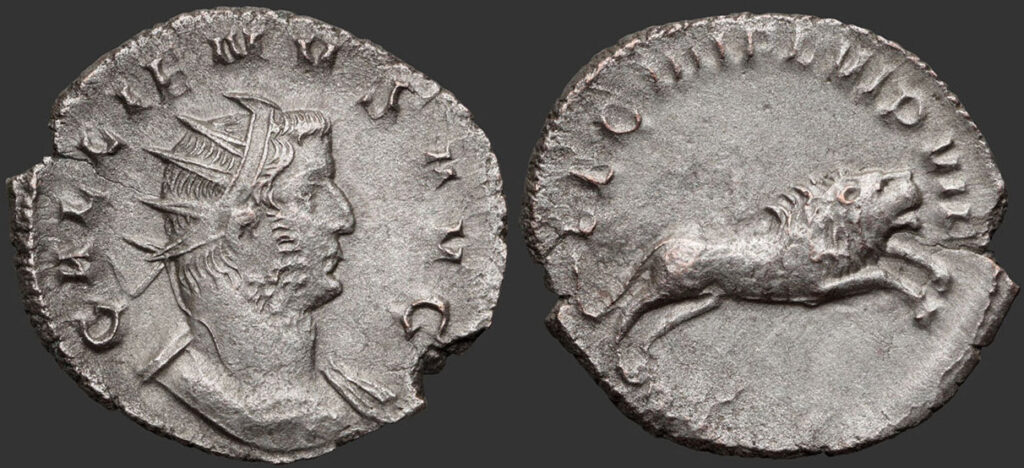
GALLIENUS Antoninianus VF
1,415.00 US$
Weight 3.29 g – Diameter 22.2 mm
Reference MIR 1002n – RIC 343 – Cohen 500
Legionary issue : Legio IIII Flavia Felix
One of the finest known examples, realistic lion
Obverse GALLIENVS AVG
Buste radié et cuirassé de Gallien à droite
Reverse LEG IIII FL VI P VI F
Lion bondissant à droite
Denomination Antoninianus
Date AD 260-261
Mint Mediolanum (Milan)
Metal Billon
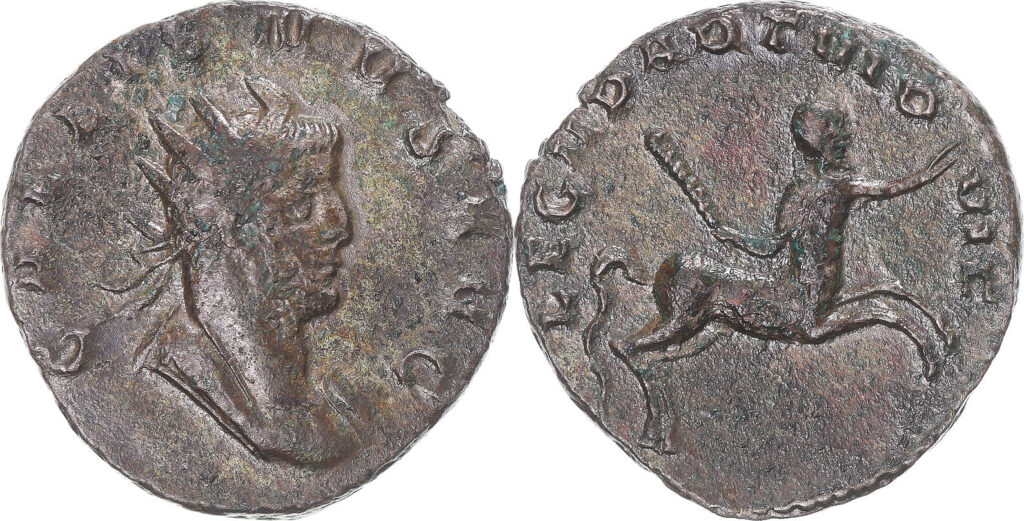
Antoninianus 258 Mediolanca. Gallienus, Mediolanum, Billon, EF(40-45)
650.00 US$
Material: Billon
Weight: 3.66 g – Diameter: 20.40 mm
Mint mark: Mediolanum
Obv: Bust of Gallienus, radiate, cuirassed, right
Rev: Centaur prancing to right, holding club.
Extremely rare! Struck during the reign of Valerian I, his father. RIC V Gallienus (joint reign) 336, GALLIENVS AVG, LEG II PART VI P VI F
About Us:

MA-Shops.com, The World’s Most Trusted Numismatic Marketplace, offers more than a million ancient, U.S. and ancient coins, along with medals, banknotes, militaria and antiquities. Our vibrant collection is offered by verified and Certified Dealers from around the world. Collectors can search, select and purchase conveniently and confidently knowing every item is authentic and guaranteed. Founded in 2005 by Joachim Schwiening, MA-Shops has offices in Germany and the US.
To become a dealer or for more information, contact us at MA-Shops.com