Carlo Ludovico Ferdinando was born on December 22, 1799, into the Bourbon-Parma family, a European royal house with connections to both Spain and Italy. His childhood, however, was shaped not by his family’s wishes but by the politics of Napoleon Bonaparte.
In 1801, Napoleon created a small new state in central Italy called the Kingdom of Etruria. It included most of what had once been the Grand Duchy of Tuscany. Napoleon handed this new kingdom to Carlo Ludovico’s parents as a political arrangement: his father, Louis (Luigi I), became the first king of Etruria, and the family moved to Florence.
For two years, Carlo Ludovico lived in the royal palace as the king’s young son. Then, in 1803, his father died suddenly. Carlo Ludovico was only three years old, but by hereditary rule, he became the second king of Etruria. Because he was too young to govern, his mother, Maria Luisa of Spain, served as regent and made all decisions in his name.
Although he carried the title of king, Carlo Ludovico spent his early childhood like any small boy. He was surrounded by tutors, attendants, and members of the court, but he had no real understanding of his role. Meanwhile, his mother managed the government while trying to keep peace with Napoleon, who increasingly treated Etruria as a territory under his control.
In 1807, Napoleon decided to abolish the Kingdom of Etruria entirely. He wanted to reorganize Italian lands to suit his own strategy, and Etruria no longer fit his plans. Carlo Ludovico, now seven years old, lost his kingdom before he had ever exercised any authority. The royal family was ordered to leave, and Florence was placed under French administration.
After the kingdom disappeared, Carlo Ludovico and his mother lived in various European courts, often under pressure from Napoleon. He grew up with a lost crown in his past — a king in name but never in practice.
Years later, after Napoleon fell, Carlo Ludovico was compensated with another small state, the Duchy of Lucca, where he ruled from 1824 to 1847. After that he became Duke of Parma for a short time before abdicating.
But the Kingdom of Etruria remained a short chapter:
Created in 1801, ruled briefly by Carlo Ludovico’s family, and gone by 1807.
Carlo Ludovico’s role in it was simple: he was a child who inherited a crown too early, lost it too soon, and remembered it for the rest of his life.
The Kingdom of Etruria existed between 1801 and 1807.
The realm was ruled first by Ludovico I di Borbone (1801–1803), and after his death his young son Carlo Ludovico inherited the crown (though real power was held by his mother as regent).
During that time, coins were struck for the kingdom — official currency in circulation under the Etrurian regime.
Thus, Etrurian coins are genuine historical artifacts tied to that brief period, and some carry the names and symbols of the Bourbon-Parma rulers (or their regency).

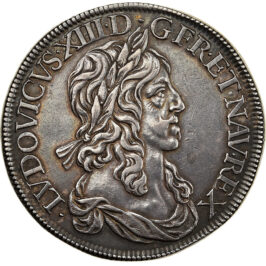
10 Lire Italy – Kingdom of Etruria – Carlo Ludovico, 1803-1807 RRR UNC-
5,775.00 US$
Grade: (plural: lire) was the currency of the Grand Duchy
Diameter: 44.00 mm
Weight 39,39gr. | Silver Ø 44mm.
Obv. Joint draped portraits of Charles-Louis (Charles II de Bourbon-Parme) as a child and his mother Marie-Louise d’Étrurie (Marie-Louise-Joséphine de Bourbon), right., LS monogram and Marteau below, surrounded by the legend CAROLUS LUD.D·G·
REX ETR. & M. ALOYSIA R. RECTRIX I·I·H·H·
Rev. Crowned shield with spikes divides wreath, FLORENTIAE 1806 below, surrounded by the legend
DOMINE SPES MEA – A IUVENTUTE MEA
After Napoleon’s fall, in 1817, Infanta Maria Luisa became Duchess of Lucca in her own right and Charles Louis, age sixteen, became hereditary Prince of Lucca. In 1820 he married Princess Maria Teresa of Savoy. They were a mismatched couple and had only one surviving son.
At his mother’s death in 1824, Charles Louis became the reigning Duke of Lucca as Charles I. He had little interest in ruling. He left the duchy in the hands of his ministers and spent most of his time traveling around Europe. A liberal movement led him to abdicate Lucca in favor of the Grand Duke of Tuscany in October 1847 in exchange for financial compensation, as he wanted to retire to private life. Two months later, in December 1847, at the death of the former Empress Marie Louise, he succeeded her as the reigning Duke of Parma according to what had been stipulated by the Congress of Vienna.
His reign in Parma as Duke Charles II was brief. He was ill-received by his new subjects and within a few months he was ousted by a revolution. He regained control of Parma under the protection of Austrian troops, but finally abdicated in favor of his son Charles III on 14 March 1849. His son was assassinated in 1854 and his grandson Robert I, the last reigning Duke of Parma, was deposed in 1860.
In exile Charles Louis assumed the title of count of Villafranca. He spent the last years of his life mostly in France, dying at Nice on 16 April 1883. The lira (plural: lire) was the currency of the Grand Duchy of Tuscany until its annexation by Napoleonic France in 1807. After that year, it unofficially remained in circulation thanks to its silver value until the restoration of Tuscan independence in 1814. It was finally abolished in 1826.
The lira was subdivided into 20 soldi, each of 3 quattrini or 12 denari (singular: soldo, quattrino, denaro). Other denominations included the crazia worth q.5 | the grosso worth q.20 | the paolo worth q.40 or 2/3 lira the testone worth 3 paoli and the crown-sized francescone worth 10 paoli or 6+2/3 lire.
In 1803 the Tuscan lira was equivalent to 0.84 French francs, 0.84 Italian lira, or 3.78 grams of fine silver. In 1826 it was replaced by the Tuscan fiorino worth 100 quattrini or 1+2/3 lira. So this 10 lire was equivalent to 15 paoli. The Italian States Tuscany 10 Lire 1806 coin is a rare and valuable piece of history.
Minted in Florence during the reign of Charles Louis, this silver coin weighs 39.39 grams and has a mintage of only circa 5,200 pieces. In 1806, Tuscany was part of the Italian States and was ruled by various branches of the House of Habsburg-Lorraine.
Charles Louis was the Grand Duke of Tuscany from 1799 to 1803, and his reign was marked by political turmoil and Napoleonic invasions. This coin is in Almost Uncirculated condition with blooming lustre, making it a highly sought-after collector’s item among numismatists. Its rarity and historical significance make it a valuable addition to any collection of Italian coinage from the early 19th century. From the year 1806 only 5,200 pieces were minted. On this specimen the year 1806 has been changed from 1805. The 1 stands upside down.
Unpublished as such.
Extremely rare as such. cf. Craig 49.1 | cf. Numista 21650 | cf. Davenport 152 RRR unc-
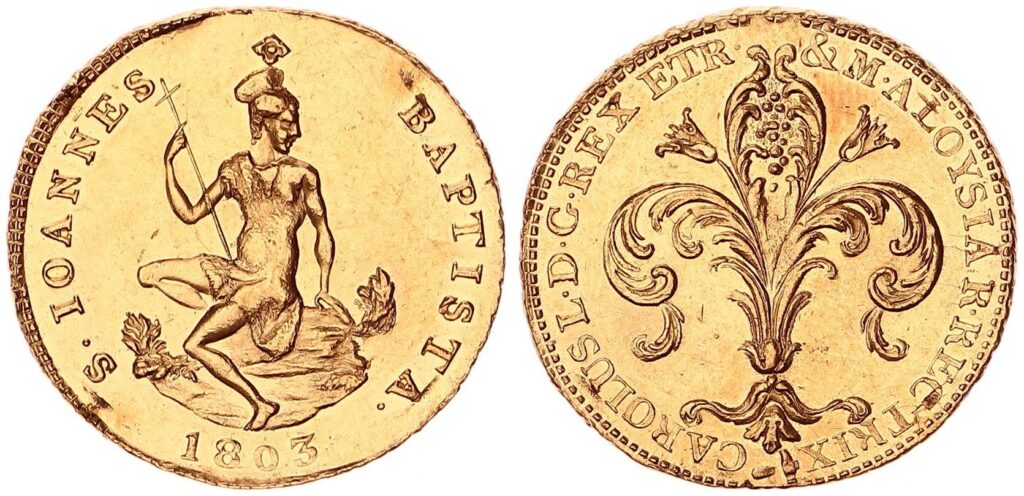
Italy, Lorraine Ruspone, 3 Zecchini 1803 Carlo Ludovico Rare AU
4,025.00 US$
Material: Gold
Weight: 10.47 g
Grand Duchy of Tuscany.
3 Zecchini 1803, Carlo Ludovico di Borbone (1803-1807)
Obverse: Florentine fleur-de-lis
Reverse: John the Baptist, holding a cross in his right hand.
Small margin errors.
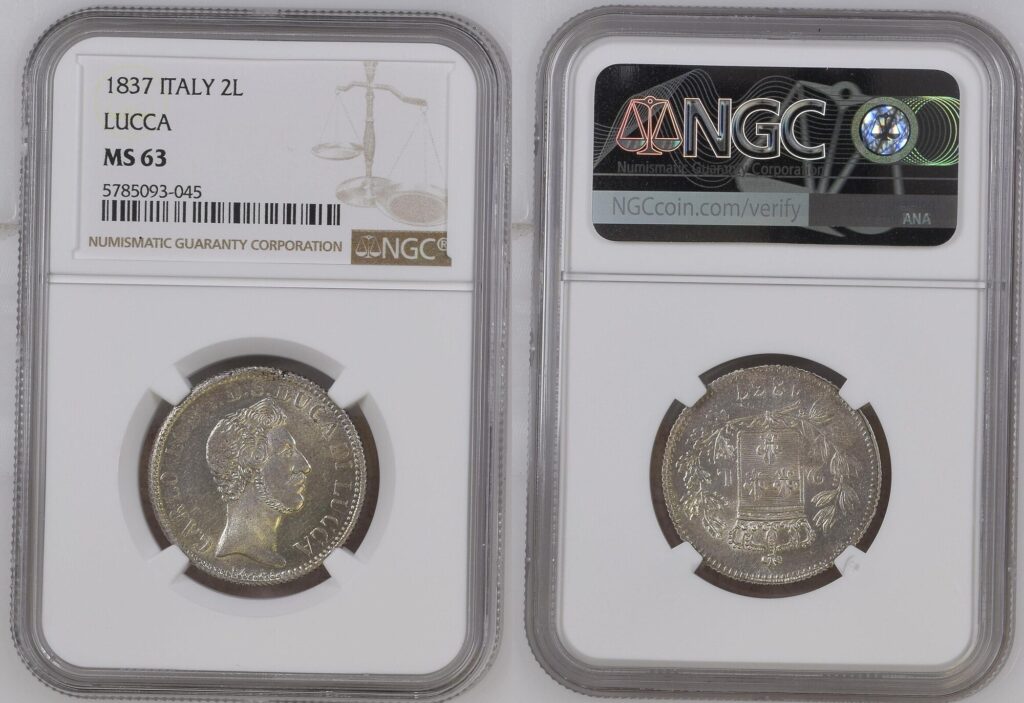
Lucca 2 lire 1837, NGC MS63, Duke Carlo Ludovico di Borbone (1824 – 1847) Lucca 1837, NGC MS63
1,750.00 US$
Krause number C# 41
Period Duchy of Lucca (1817 – 1847)
Ruler Duke Carlo Ludovico di Borbone (1824 – 1847)
Composition Silver 0.900
Weight: 5 gr. – Diameter: 23 mmh
Mintage 153.047
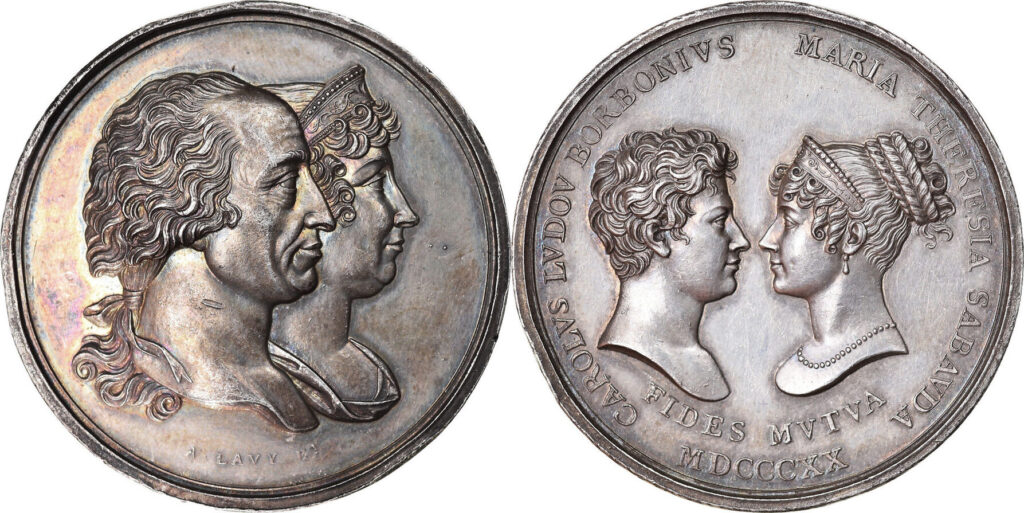
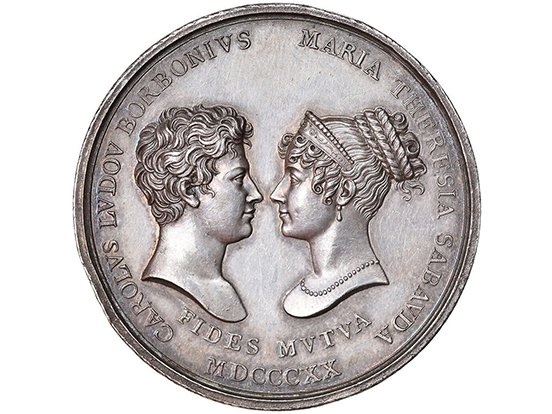
Italy Medal 1820 Wedding of Carlo Ludovico & Maria Teresa, A. Lavy MS(60-62)
1,025.00 US$
Material: Silver
Weight: 34.26 g – Diameter: 40.00 mm
Medal graver: A. Lavy
Obv: Conjointed busts of Vittorio Emanuele I and Maria Antonietta.
Rev: Confronted busts of the wedded Carlo Ludovico and Maria Teresa., CAROLVS LVDOV BORBONIVS MARIA THERESIA SABAVDA // FIDES MVTVA / MDCCCXX
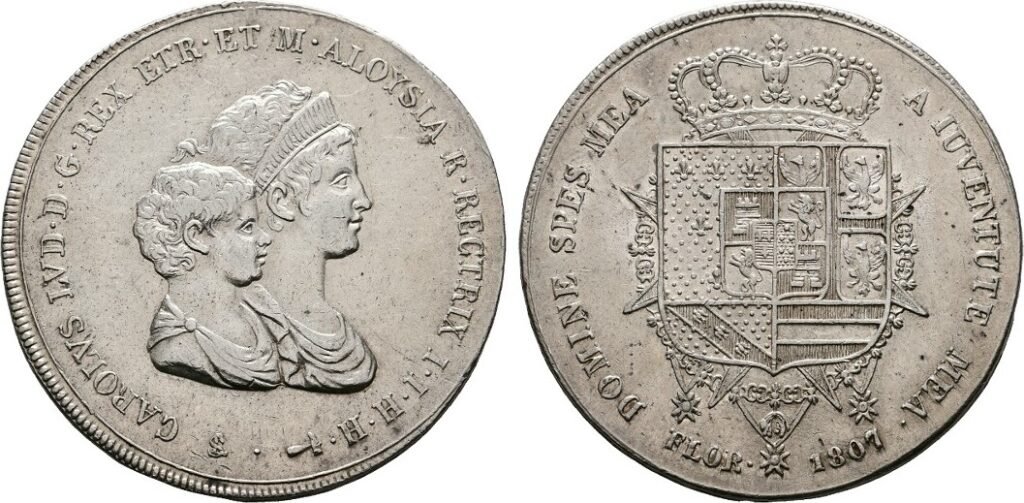
ITALY 1 1/2 Francescone (Dena) 1807, Florence. Carlo Ludovico di Borbone, Light patina. EF
870.00 US$
King of Tuscany, and his mother Maria Luigia, 1803-1807. TOSCANA
Material: Silver
Catalog: Dav. 152; Pagani 23
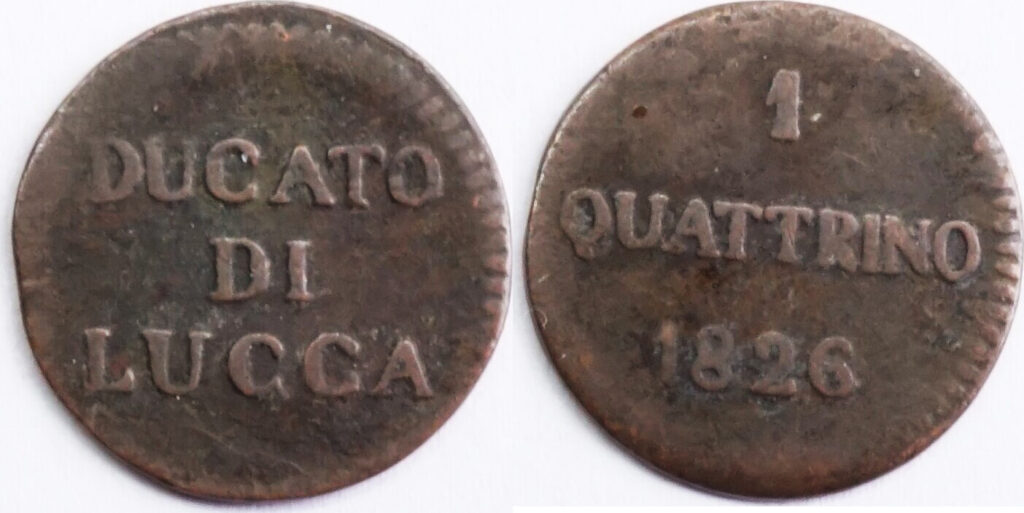
Italy, Lucca 1 Quattrino 1826 Carlo Ludovico I VF+
65.00 US$
Catalog: KM# A31, CNI XI# 10, MIR# 252
Material: Copper
Weight: 1.14 g – Diameter: 15.00 mm
Mintage: 389.540
About Us:

MA-Shops.com, The World’s Most Trusted Numismatic Marketplace, offers more than a million ancient, U.S. and ancient coins, along with medals, banknotes, militaria and antiquities. Our vibrant collection is offered by verified and Certified Dealers from around the world. Collectors can search, select and purchase conveniently and confidently knowing every item is authentic and guaranteed. Founded in 2005 by Joachim Schwiening, MA-Shops has offices in Germany and the US.
To become a dealer or for more information, contact us at MA-Shops.com